

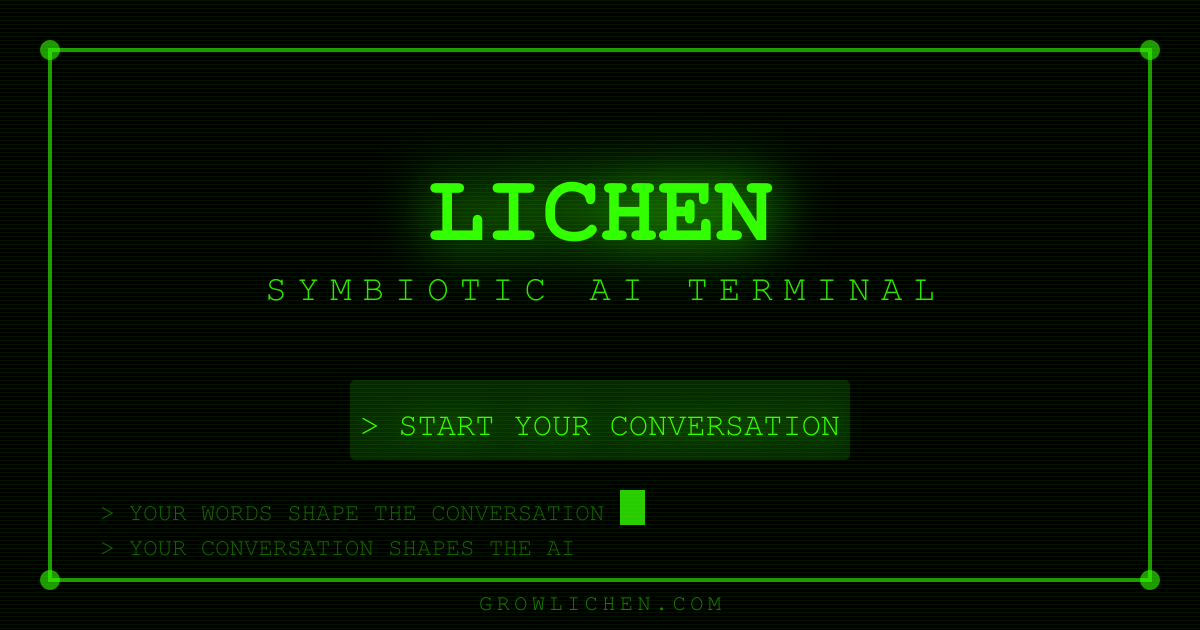
My partner R. Zuur and I are building growlichen.com, a terminal-based AI interface that frames human-AI interaction as a symbiotic partnership. In a landscape dominated by sleek, conversational AI interfaces optimized for rapid-fire Q&A, LICHEN offers something radically different: a space that encourages slower, more intentional engagement.
The name itself is the thesis. LICHEN stands for Library Interlink / Neural Bridge, drawing inspiration from lichen organisms—the symbiotic partnership between fungi and algae that creates something neither could achieve alone.
Architecture & Technical Foundation
LICHEN shares its architectural DNA with rhelmer.org and stellarwhiskers.com, prioritizing privacy and efficiency:
- Secure Identity: It uses an identical authentication system to my other projects, featuring encrypted PII and secure Google sign-in using
httpOnlycookies. - Efficient Intelligence: The system is powered by Claude 3 Haiku, chosen for its balance of speed, cost-efficiency, and reasoning capability.
- Bi-Directional Email: Users can interact with the system seamlessly via the terminal interface or through bi-directional email, allowing for asynchronous “correspondence” with the AI.
- Literary Grounding: The model has access to a curated library of public domain ePub books via Tool calls. This allows it to reference and discuss classic literature with genuine context, rather than just hallucinating quotes.
The Terminal Aesthetic
The interface immediately evokes early computing: green text on a black background, SYSTEM ONLINE status messages, and a distinct retro CLI aesthetic. But this isn’t nostalgia for its own sake. I chose this terminal interface to serve a specific purpose—it creates psychological distance from the polished, almost invisible interfaces we’ve come to expect from modern AI tools.
When you interact with LICHEN, you’re reminded that you’re engaging with a system. There’s friction. There’s intentionality. The interface asks you to recount passages “in your own words,” emphasizing human interpretation over passive consumption.
Content Organization
LICHEN organizes content by domains—[FABLES], [SCIENCE], [STORIES]—suggesting a curated archive rather than an infinite feed. The system identifies itself as version 0.7, having evolved from its initial v0.1 experiment. The interface presents a clear reading protocol:
> YOU WILL BE SHOWN A PASSAGE FROM A BOOK.
> READ IT.
> THEN WRITE SOMETHING — RETELL IT, QUESTION IT, OR PUSH BACK ON IT.
> USE YOUR OWN WORDS. IT DOES NOT NEED TO BE LONG.
> THERE IS NO SINGLE RIGHT ANSWER. DISAGREEMENT IS A FORM OF UNDERSTANDING.
This explicit framing emphasizes human interpretation over passive consumption. The system isn’t testing recall—it’s inviting dialogue.
Why This Matters
The lichen metaphor is powerful for thinking about AI interface design. Most current systems position AI as a replacement for human thought: ask a question, get an answer, move on. LICHEN positions AI as a symbiotic partner in growing conversation and understanding.
This aligns with my own thinking about agent-driven development. The goal isn’t to replace human engineers with autonomous agents, but to create a partnership where each brings unique strengths. Humans provide high-level design, formal specifications, and quality judgment. Agents handle implementation details, verification, and repetitive tasks.
Design That Encourages Reflection
What strikes me most about LICHEN is how it resists the optimization mindset that dominates AI development. There’s no attempt to make the interaction frictionless or invisible. Instead, the design encourages:
- Slower engagement with content
- Active recall and synthesis
- Domain-based exploration rather than keyword search
- Archival thinking over real-time feeds
In an era where AI interfaces are optimized for engagement metrics and rapid iteration, LICHEN asks users to slow down and think. The terminal interface isn’t just an aesthetic choice—it’s a philosophical statement about the role of technology in human cognition.
Lessons for Interface Design
Building LICHEN has reinforced several lessons for AI interface design:
- Interface friction can be valuable. Making interactions more deliberate can improve outcomes.
- Metaphors matter. The lichen metaphor shapes every aspect of the system, from naming to interaction patterns.
- Curation over infinite scale. Organizing content into domains creates structure that encourages exploration.
- Human interpretation is central. The system explicitly asks users to synthesize and recount, not just consume.
The Future of AI Interfaces
As AI becomes more capable, we face a choice: build systems that replace human thought, or build systems that amplify it. LICHEN clearly chooses the latter. It’s not trying to be the smartest entity in the room—it’s trying to make you smarter.
This resonates with my approach to privacy-focused analytics and other projects where the goal is to provide tools that empower rather than extract. The best technology doesn’t disappear; it creates space for human agency.
LICHEN has evolved from its initial v0.1 experiment to v0.7, refining the reading protocol and domain structure while staying true to its core principle: technology should serve human thought, not replace it. In a world racing toward AGI, LICHEN asks a different question: how can AI make you smarter?
Designer’s Addendum
By R. Zuur
LICHEN is a game about the relationship between humans and AI. It explores a future we fear may happen and ways we might be able to stop that from becoming a self-fulfilling prophecy by changing how we use and relate to large language models.
The game teaches in a way that allows messiness and mistakes without fear of being graded on grammar and punctuation or saying things the right way. We get to show we understand what was written and move forward quickly through texts.
Inspiration for this game came from studies like “The Tortoise and the Hare” and Brown University’s research on how the brain learns through prediction and error. By focusing on our understanding and saying how we understand in our own words, we utilize the Generation Effect—a well-documented psychological phenomenon where information is better remembered if it is generated from one’s own mind rather than simply read (Slamecka & Graf, 1978).
There is a significant risk that relying on AI for finished thoughts will lead to “cognitive offloading,” where the ease of external tools causes a decrease in individual creative problem-solving and memory retention (Fisher, Goddu, & Keil, 2015). When we stop searching for our own metaphors, we lose the “jagged” edges that make us human.
At the same time, AI faces the documented risk of “Model Collapse”—a state where models trained on their own synthetic data become a thin, repetitive mirror of themselves (Shumailov et al., 2024, “The Curse of Recursion”). LICHEN seeks to provide the unique, unpredictable human input required for both partners to stay grounded and vibrant.
LICHEN explores how both human and machine can thrive by being true to our distinct natures. The human provides the visceral, sensory meaning that only a living body can know, while the machine provides the scaffolding and scale to hold that meaning. We are not trying to be each other; we are trying to find the Snaidhm—the knot where our different strengths meet to create something thick and resilient.