
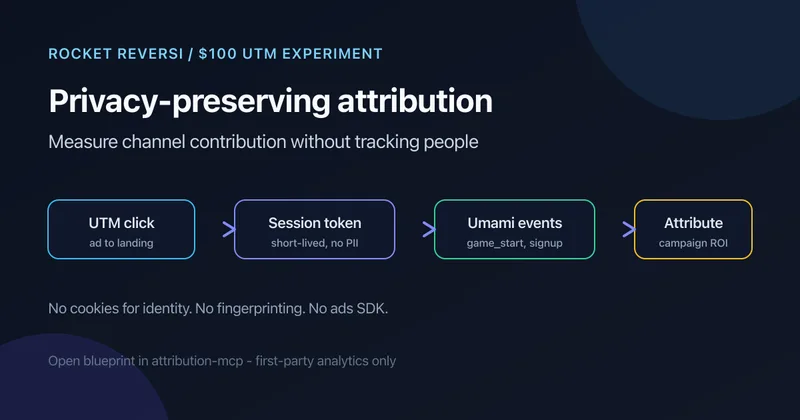

Rocket Reversi: Privacy-Preserving Attribution End-to-End
Rocket Reversi is live, and we proved something that usually requires third-party cookies, tracking pixels, and walled-garden APIs: you can measure where players come from without tracking people.
The experiment
- Budget: $100 UTM campaign
- Stack: Umami self-hosted analytics, rotating session tokens, no cross-site identifiers, no ads SDK
- Goal: prove we could detect channel contribution end-to-end while keeping the implementation privacy-preserving
What we built
Instead of persistent identifiers or fingerprinting, Rocket Reversi uses short-lived session tokens tied to a single visit. The flow:
- User arrives via a tracked link (
utm_source,utm_medium,utm_campaign) - Session token is created server-side and stored in a partitioned cookie scope
- Game events emit Umami custom events with the session token, not a user ID
- Attribution reports match sessions to campaigns without reconstructing identity
This keeps the data useful for growth decisions while avoiding the surveillance model typical of ad attribution.
Results
- Captured full click-to-play attribution in Umami
- Correlated campaign traffic with
auth_signup_successandgame_startevents - Zero PII in analytics exports; export schema is auditable
Why this matters
The industry is moving back toward privacy-first analytics and static-site hosting. If you want to prove ROI on a small marketing budget without depending on Google Analytics, ad pixels, or cloud ad platforms, this case study gives you a runnable blueprint.
Try it yourself
The implementation is open source in attribution-mcp. If you want the Umami MCP + UTM session-token pattern for your own project, start there.
If you want to see more privacy-first infrastructure for indie studios, follow along or reach out. This repo will keep publishing what we learn.